
4 Equipment Solutions for a More Efficient Commercial Kitchen
25 Sep 2026, Posted by in BlogThere are plenty of ways for a commercial kitchen to get busy.
Orders pile up. Counter space disappears. Something needs to be ready five minutes ago. And the food you finished cooking 20 minutes ago still needs to be ready when service catches up.
Just another day in foodservice.
The good news? Creating a more efficient kitchen doesn’t necessarily mean working faster. It means having the right equipment in the right places so your team can make better use of its space, time, and labor.
So instead of looking at kitchen efficiency as one big problem, let’s break it down.
Four common challenges. Four equipment solutions.
Challenge #1: You Need More Production. You Don’t Have More Space.
More kitchen would be nice.
Unfortunately, knocking down a wall isn’t usually on the equipment budget.
That’s where the Eloma COMPACT PRO comes in.
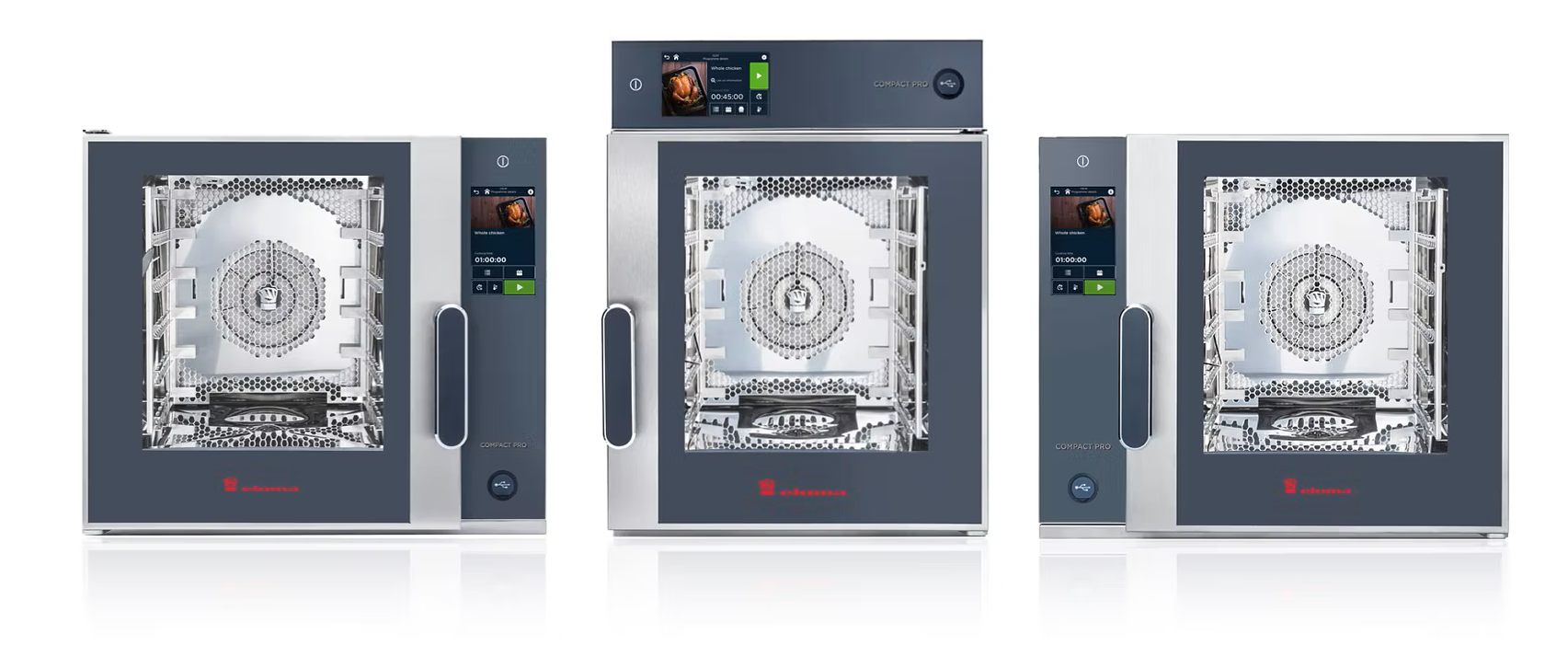
Designed as a configurable compact-class solution, the COMPACT PRO packs serious cooking capability into a space-efficient footprint. Multiple cavity sizes and configurations allow operators to choose a setup that fits their operation rather than trying to make their operation fit the equipment.
And compact doesn’t mean limited.
Depending on the configuration, the COMPACT PRO can be set up as a convection oven, baking oven, or combi steamer, giving operators flexibility to tackle different production needs while making smarter use of valuable kitchen space.
For operations trying to increase production without increasing their footprint, that’s a pretty compelling equation.
More capability. Same kitchen. No sledgehammer required.
Challenge #2: You Need It Now.
Then there are the orders that don’t care what else is happening in your kitchen.
A quick reheat. An individual order. An item that needs to be regenerated and out the door.
That’s where the Amana HDC 1800/2100 commercial microwave earns its counter space.
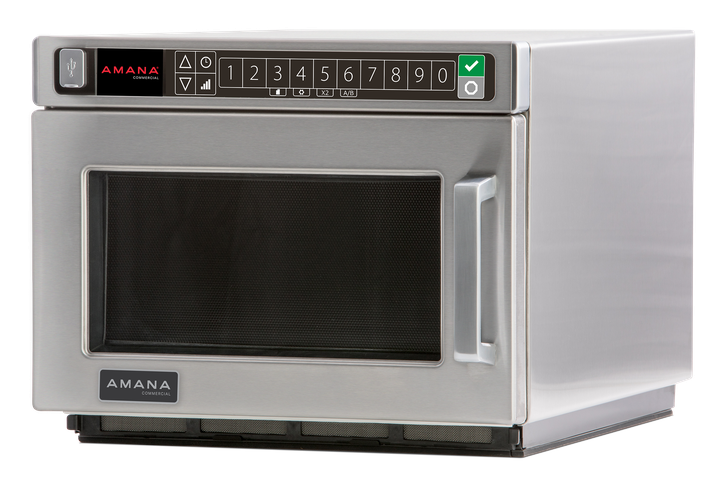
With 1800 to 2100 watts of cooking power, the HDC 1800/2100 is designed for faster cooking, steaming and regenerating with more throughput. Its compact footprint gives busy commercial kitchens a powerful option for quick-turn items without taking over valuable counter space.
The advanced controller offers up to 100 programmable menu items, while Smart USB makes it easier to update menus across multiple ovens and locations.
And because no ventilation is required, operators have more flexibility when deciding where that extra speed makes the most sense.
Because when the ticket says ASAP, telling it you’re already busy doesn’t seem to help.
Challenge #3: The Food Is Ready. The Customer Isn’t.
Getting food cooked on time is one thing.
Getting your customers to show up exactly when it’s ready? Good luck with that.
Production and service don’t always run on the same schedule, which makes reliable hot holding an important part of keeping the kitchen moving.
The Cres Cor H-339-SS Series gives operators an undercounter hot-holding solution designed to keep prepared foods at serving temperatures while making smart use of available space.
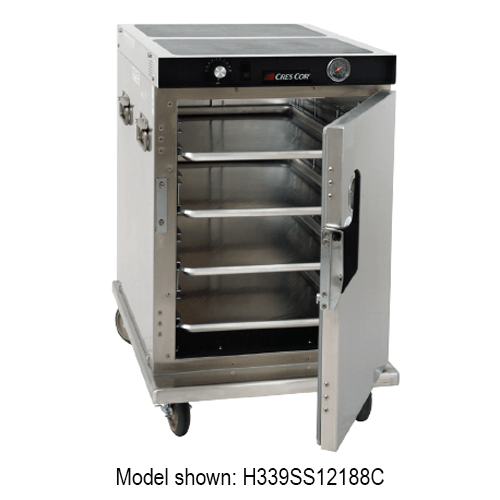
The fully insulated cabinet uses a 900-watt heating system and can heat up to 200°F. Different configurations accommodate common pan sizes, with removable pan supports available on applicable models for easier cleaning.
And because it fits under the counter, operators can add dedicated holding capacity without asking an already-crowded kitchen to magically find more floor space.
Cook when it makes sense. Hold until it’s needed. Keep service moving.
Challenge #4: Hot and Ready Should Still Mean Good.
Holding food is useful.
Holding food while maintaining the quality your customer expects is better.
The Antunes PrecisionCrisp is designed to keep meals hot and ready to serve while helping operators preserve quality and food safety.
The compact tabletop unit uses high-performance ceramic heaters to keep food above 140°F internally for at least 20 minutes. It can accommodate one full-size hotel pan or two half-size pans up to six inches deep, giving operators a flexible option for keeping food hot and ready during service.
That can be especially useful when the goal is to prepare ahead enough to keep up with demand without getting so far ahead that quality pays the price.
Because “technically still hot” isn’t exactly the standard we’re aiming for.
Efficiency Isn’t One Piece of Equipment
The most efficient kitchen isn’t necessarily the one with the most equipment.
And it definitely isn’t the one where everyone just moves faster.
It’s the one where each part of the operation has been thought through.
Where production equipment makes good use of available space. Where quick-turn needs don’t derail the rest of the kitchen. Where finished food has somewhere to go until it’s needed. And where items can stay hot and ready without sacrificing the quality customers expect.
That’s why there’s no single answer to “How do I make my kitchen more efficient?”
A better question is: Where is your operation losing efficiency right now?
Maybe you’re running out of production space. Maybe speed is the problem. Maybe you’re struggling with the gap between when food is ready and when customers are ready for it. Or maybe your holding setup is creating a quality problem you shouldn’t have to accept.
FH&W can help you find the equipment solution that fits the way your kitchen actually works.
Ready to tackle your kitchen’s biggest efficiency challenge? Contact FH&W to start the conversation.