
High-Volume Days, Handled: Solutions That Keep Service from Going Sideways
13 Feb 2026, Posted by in Blog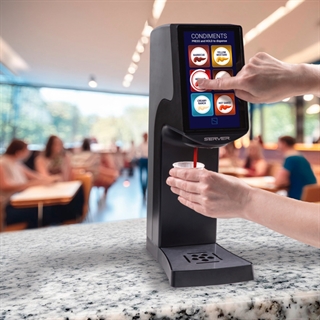
What You’ll Learn (Because the Rush Does Not Care How Prepared You Feel)
High-volume days do not warm you up. They hit fast, fill the line, and immediately expose whatever is not working behind the scenes. In healthcare, K–12, and convenience stores, those days are not occasional curveballs. They are built into the schedule.
This blog breaks down how the right mix of holding, consistency, and dispensing solutions help teams stay in control when volume spikes. Not in a perfect-world scenario. In real operations, with real staffing limits and very little margin for error.
What Does High-Volume Service Really Look Like?
It looks like a hospital trayline firing all at once. A school cafeteria pushing through lunch period after lunch period. A c-store hot food program that gets busy before the coffee is even finished brewing.
Across segments, the challenges are familiar:
- Big volumes packed into short service windows
- Lean teams juggling speed and accuracy
- Guests who notice immediately when food is late, cold, or inconsistent
High-volume success is not about pulling off a miracle during the rush. It is about having systems that do not fall apart when the pressure shows up.
Holding Is the Backbone of High-Volume Service
If high-volume days start to wobble anywhere, it usually comes down to temperature control and timing. When food cannot be cooked, rethermed, or held properly, the pressure builds quickly and shows up on the line.
That is where Cres Cor and Flexeserve make a real difference.
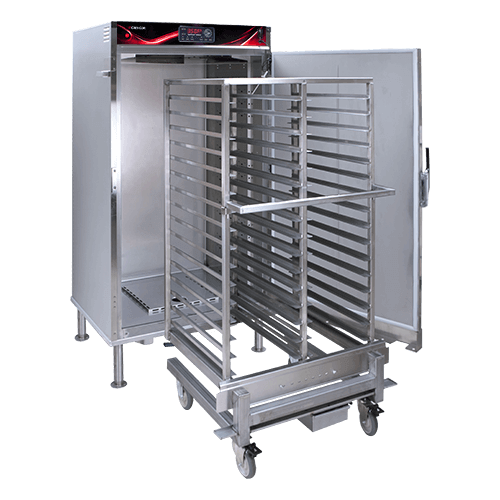
Cres Cor supports both sides of high-volume service. Their RO and CO ovens allow operators to cook and retherm efficiently, even in facilities with limited hood space. In healthcare and K–12 environments especially, that flexibility can be the difference between keeping up and playing catch-up.
Once food is prepared, Cres Cor hot and cold holding cabinets maintain safe, consistent temperatures without constant oversight. Mobile designs give teams room to adjust when service patterns shift or space gets tight.
Flexeserve extends hold times while protecting food quality, which matters when lunch runs long or traffic hits in waves.
When cooking and holding are working together instead of fighting each other, teams stop reacting and start running the shift.
Portion Control Is a Small Detail That Causes Big Headaches
On high-volume days, portioning mistakes show up fast. Over-portioning eats into margins. Under-portioning creates unhappy guests. Neither one is easy to fix once the line is moving.
Server Products dispensing solutions help teams hit the same portion every time without slowing service down. Pumps, dispensers, and heated systems are designed for speed, accuracy, and minimal mess.
The payoff is simple:
- Consistent portions across every shift
- Less waste during peak periods
- Fewer slowdowns caused by re-dos or complaints
It is one of those behind-the-scenes details that keeps busy days from turning into long ones.
Consistency at Scale: Where Antunes Fits
High-volume service leaves very little room for improvisation. Food needs to come out right every time, no matter who is working the line or how busy it gets.
Antunes equipment is built for exactly that kind of pressure. Their vertical contact toasters, steamers, and egg stations help deliver repeatable results at high speed, shift after shift.
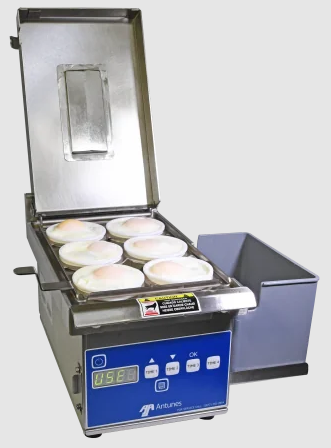
Vertical contact toasters take timing and guesswork out of toasting. Steamers help sandwiches and proteins come together quickly and evenly. Egg stations support fast, standardized breakfast production, especially in K–12 and c-store environments where volume hits early and all at once.
Together, these solutions reduce variation, limit rework, and help teams keep pace when expectations stay high and time does not.
When the System Works, Busy Days Feel Different
High-volume days will always be busy. That part does not change. What can change is how they feel to the team working them.
When holding, consistency, and dispensing solutions work together, service becomes more controlled and less reactive. Fewer surprises show up on the line. Fewer problems need fixing mid-shift.
At Forbes Hever and Wallace, we work with operators who live these days every week. Our team helps identify pressure points, talk through workflows, and match solutions to how food actually moves during peak service.
If high-volume days are part of your everyday reality, FH&W is here to help you build a setup that is ready before the rush hits. Because when service gets busy, the goal is not to survive the day. It is to walk out knowing your systems did exactly what they were supposed to do.